1. Latest News — Sierra EV Debut Confirmed for June 30, 2026 {#latest-news}
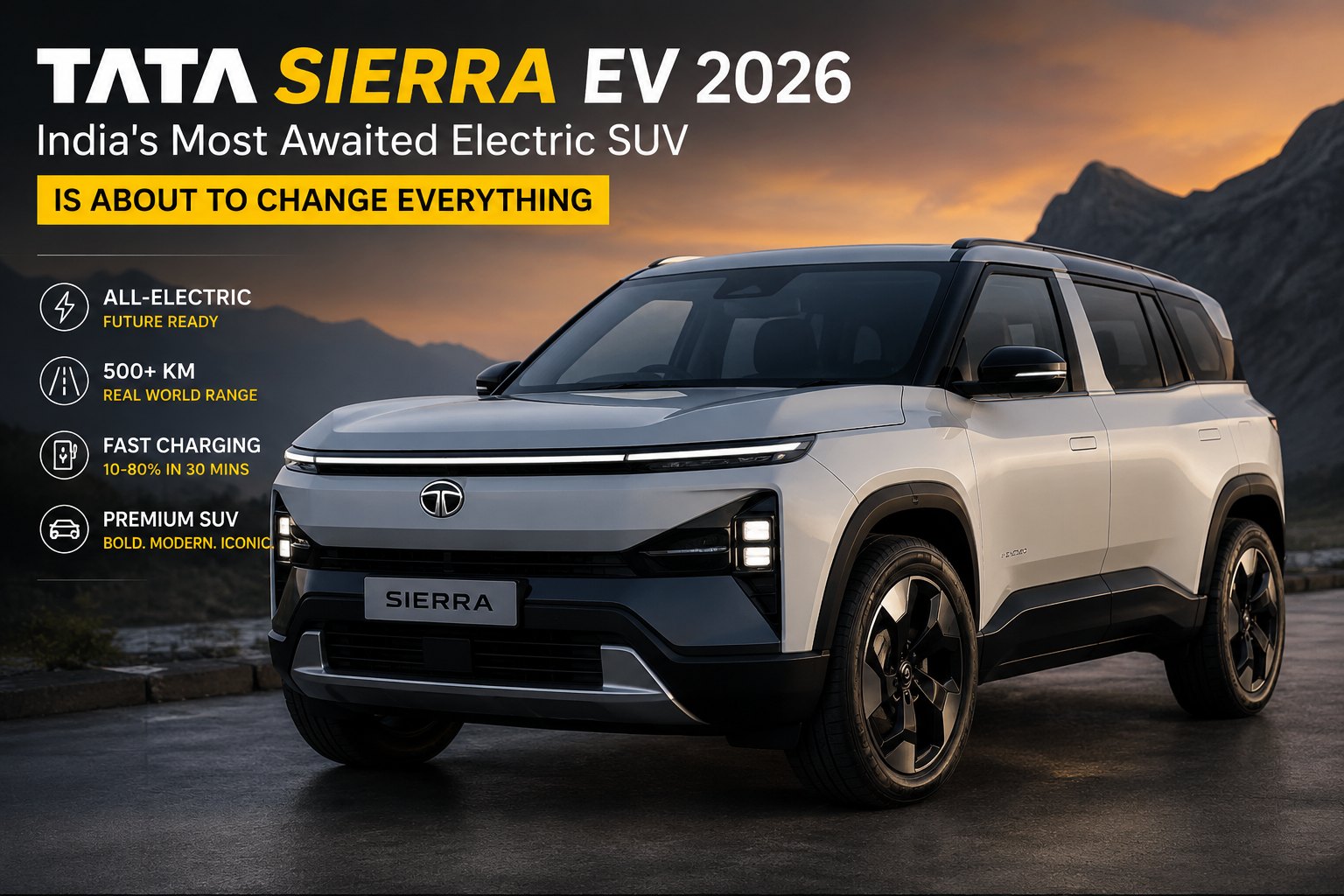
Tata Motors has officially confirmed that the Sierra EV will be unveiled to the public on June 30, 2026. This announcement comes after months of testing across India, including multiple camouflaged sightings that generated intense discussion among enthusiasts online.
The commercial launch — meaning showroom availability and pricing — is expected between July and September 2026, as confirmed by Shailesh Chandra, Managing Director and CEO of Tata Motors Passenger Vehicles. The company has positioned this window deliberately to align with festive season bookings and fleet delivery timelines.
Most recently, Tata also released a teaser confirming that the Sierra EV will feature an AWD (all-wheel drive) system — something the ICE version does not offer. This dual-motor setup, which Tata calls QWD (Quad Wheel Drive), is the same configuration used in the Harrier EV. That detail alone separates the Sierra EV from every other EV in its price bracket.
2. Design — The Legend Lives On {#design}
If you grew up in the 1990s, the original Tata Sierra holds a special place in memory. The three-door, boxy SUV with a panoramic rear glass section was unlike anything else on Indian roads at the time. Tata has been careful to honour that legacy.
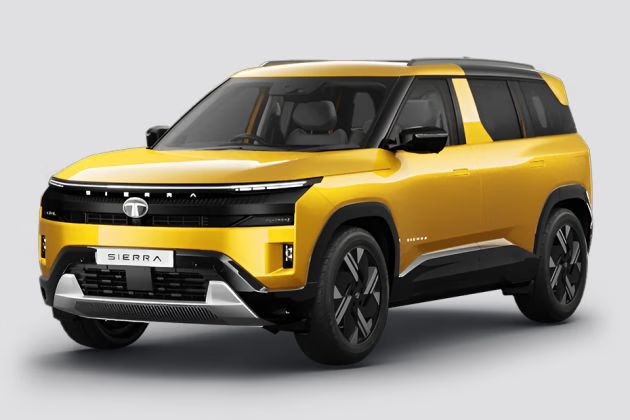
The Tata Sierra EV 2026 keeps the upright bonnet, squared shoulders, and unmistakable silhouette of its ancestor. But the execution is entirely modern. The front gets split LED headlamps, a blanked-off grille (the unmistakable EV design language), and flush-fitting door handles that slide out electronically when you approach.
The rear continues the squared-off design with a connected LED lightbar, wraparound taillights, and a dual-tone body option. The glass roof — the signature feature of the original Sierra — returns in a redesigned form that now complies with all modern safety regulations.
Available colours are expected to be White, Red, Black, and Yellow — with Yellow likely to become the signature shade of the Sierra EV just as it became iconic on the ICE version.
Rolling stock will be aerodynamic alloy wheels that are designed to reduce drag and improve range — form meets function in the best possible way.
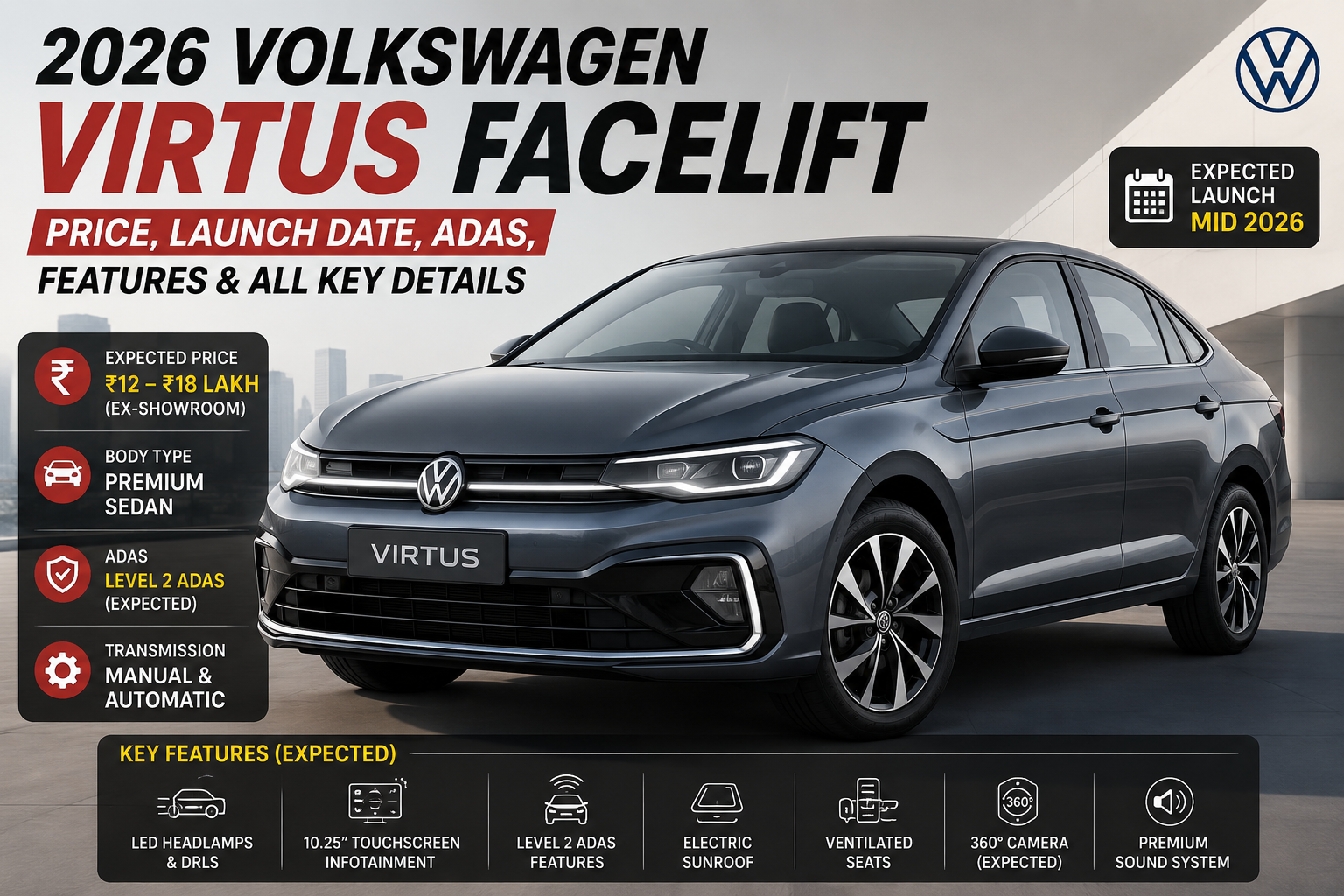
link Post : 2026 Volkswagen Virtus Facelift — Price, Launch Date, ADAS, Features & All Key Details
3. Platform & Architecture — The Acti.ev+ Foundation {#platform}
The Tata Sierra EV 2026 is built on Tata’s Acti.ev+ platform — the same advanced dedicated EV architecture that underpins the Harrier EV. This is important because it tells you what the Sierra EV is capable of at a structural level.
The Acti.ev+ platform supports:
- Dual-motor AWD configuration (QWD in Tata’s terminology)
- Independent rear suspension — for superior ride quality over India’s uneven roads
- V2L (Vehicle to Load) charging — run home appliances from your car’s battery
- V2V (Vehicle to Vehicle) charging — charge another EV from the Sierra’s battery
- DC fast charging support — compatible with high-speed public chargers
- Over-the-Air (OTA) updates — the car gets smarter over time without visiting a service centre
The platform itself has already proven its credentials through the Harrier EV’s performance. The Sierra EV benefits from that validated engineering, which means Tata is not starting from scratch — this is a refined and improved version of technology that is already on Indian roads.
4. Battery, Range & Performance Specifications {#specs}
Expected Technical Specifications
| Specification | Details |
|---|---|
| Platform | Tata Acti.ev+ (Dedicated EV) |
| Battery Options | 55 kWh / 65 kWh |
| Claimed Range (65 kWh) | 500+ km (ARAI) |
| Real-World Range (Estimated) | 430–470 km (mixed conditions) |
| Drivetrain (Base) | FWD — Single Motor |
| Drivetrain (Top) | AWD / QWD — Dual Motor |
| Fast Charging (DC) | 20%–80% in under 60 minutes |
| AC Charging | 7.2 kW onboard charger |
| V2L / V2V | Yes (bidirectional charging) |
| 0–100 km/h | Under 8.5 sec (RWD) / Under 6.5 sec (AWD, estimated) |
| Top Speed | Electronically limited, ~160 km/h |
| Suspension | MacPherson Strut (front) / IRS (rear) |
| Dimensions | Similar to Sierra ICE — compact mid-size SUV |
| Boot Space | Estimated 400–450 litres |
| Seating Capacity | 5 passengers |
| OTA Updates | Yes |
Note: All specifications are based on multiple reliable industry sources as of June 2026. Official figures will be announced at the June 30 unveiling. Some specifications may vary by variant.
The 65 kWh battery pack is the one to watch — it is expected to deliver a real-world range comfortably above 430 km, which is enough to handle a Delhi-to-Jaipur highway run on a single charge with range to spare.
The AWD top variant, powered by the dual-motor QWD setup, is expected to be the performance flagship — combining proper off-road capability with instant torque that makes highway overtakes effortless.
5. Cabin & Features — Three Screens and More {#features}
Walk into the Sierra EV’s cabin and the first thing you notice is the triple-screen dashboard — three 12.3-inch displays running seamlessly across the dashboard. The layout includes:
- 12.3-inch central touchscreen — infotainment, navigation, EV stats
- 12.3-inch digital instrument cluster — driver-facing, fully configurable
- 12.3-inch front passenger display — entertainment and system access
This triple-screen setup is the same architecture as the Harrier EV and puts the Sierra EV well ahead of the Hyundai Creta Electric on cabin technology.
Full Expected Feature List
| Feature | Available |
|---|---|
| Triple 12.3-inch Screen Setup | ✅ Yes |
| Four-Spoke Illuminated Steering Wheel | ✅ Yes |
| Panoramic Sunroof | ✅ Yes |
| Arcade.ev App Suite | ✅ Yes |
| Level 2 ADAS | ✅ Yes |
| 360-Degree Camera System | ✅ Yes |
| Digital IRVM (Interior Rear View Mirror) | ✅ Yes |
| Ventilated Front Seats | ✅ Expected |
| Powered Front Seats | ✅ Yes (top variants) |
| Dual-Zone Climate Control | ✅ Yes |
| Ambient Lighting | ✅ Yes |
| Connected Car Technology | ✅ Yes |
| OTA (Over-The-Air) Software Updates | ✅ Yes |
| V2L / V2V Bidirectional Charging | ✅ Yes |
| 6 Airbags | ✅ Yes |
| Electronic Stability Program (ESP) | ✅ Yes |
| Tyre Pressure Monitoring (TPMS) | ✅ Yes |
| Wireless Phone Charger | ✅ Expected |
| Premium Sound System | ✅ Expected |
The Level 2 ADAS suite on the Sierra EV is expected to include adaptive cruise control, automatic emergency braking, lane departure warning, and traffic sign recognition — a package that was once exclusive to luxury cars priced well above ₹30 lakh.
6. Expected Price in India {#price}
Based on multiple industry sources and analyst estimates, the Tata Sierra EV 2026 price in India is expected as follows:
| Variant | Battery | Drivetrain | Expected Price (Ex-Showroom) |
|---|---|---|---|
| Base / Standard | 55 kWh | FWD (Single Motor) | ₹17.50 – ₹19.50 Lakh |
| Mid / Smart | 55 kWh | FWD (Single Motor) | ₹19.50 – ₹21.50 Lakh |
| Top / Adventure | 65 kWh | FWD (Single Motor) | ₹21.50 – ₹23.50 Lakh |
| Flagship / QWD | 65 kWh | AWD (Dual Motor) | ₹23.50 – ₹26.00 Lakh |
BaaS Option: Tata may also offer a Battery-as-a-Service (BaaS) pricing model that reduces the upfront cost by separating the battery price from the vehicle cost. This could bring the entry price closer to ₹14–₹15 lakh for BaaS variants.
On-road prices in most Indian cities will add approximately 12–18% due to RTO registration, insurance, and local state taxes. Karnataka, for example, revised EV road tax rates from May 2026, which affects final on-road pricing in Bengaluru.
Official pricing will be announced at the June 30, 2026 launch event.
7. Competitor Comparison — Sierra EV vs 3 Key Rivals {#comparison}
Head-to-Head Comparison Table
| Feature | Tata Sierra EV 2026 | Hyundai Creta Electric | Mahindra BE 6 | Maruti e Vitara |
|---|---|---|---|---|
| Starting Price | ~₹17.50 Lakh* | ₹18.02 Lakh | ₹18.90 Lakh | ₹15.99 Lakh |
| Battery Options | 55 / 65 kWh | 42 / 51.4 kWh | 59 / 79 kWh | 48.8 / 61.1 kWh |
| Claimed Range | 500+ km (65 kWh) | 390 / 473 km | 557 / 683 km | 440 / 543 km |
| Peak Power | Est. 167–250 bhp | 135 / 171 bhp | 228 / 282 bhp | 105 / 141 bhp |
| AWD Available | ✅ Yes (QWD) | ❌ No | ❌ No | ✅ Yes |
| Bidirectional V2L | ✅ Yes | ❌ No | ✅ Yes | ❌ No |
| Triple Screen | ✅ Yes | ❌ No | ❌ No | ❌ No |
| 5-Star BNCAP | Expected | To be tested | Expected | ✅ Confirmed |
| Level 2 ADAS | ✅ Yes | ✅ Yes | ✅ Yes | ✅ Yes |
| Service Network | ★★★★★ | ★★★★ | ★★★ | ★★★★★ |
Expected price — to be confirmed on June 30, 2026.
Quick Verdict on Each Rival
Hyundai Creta Electric is the most trusted name in the segment. It has a proven track record, excellent service support, and a familiar design. But it tops out at 51.4 kWh with no AWD option, and its cabin tech feels a step behind the Sierra EV’s triple-screen setup.
Mahindra BE 6 is the performance choice. With up to 282 bhp and 683 km of range from the 79 kWh pack, it is the most powerful EV in this price range. However, it is pricier at the top, has a futuristic design that may not appeal to everyone, and Mahindra’s service network is still expanding.
Maruti e Vitara wins on value and network trust. Starting at ₹15.99 lakh with Maruti’s unbeatable 4,000+ service centre network across India, it is the no-brainer choice for buyers who prioritize peace of mind. However, it offers less cabin tech and no bidirectional charging.
Tata Sierra EV sits in a sweet spot — AWD where rivals have none, a triple-screen cabin no rival matches, V2L/V2V charging, and the emotional pull of the Sierra badge. If the pricing lands where expected, it could redefine the segment entirely.
8. Expert Opinion — Is the Sierra EV Worth the Wait? {#expert}
The Tata Sierra EV 2026 is arriving at exactly the right moment for the Indian EV market. India crossed 2 million EV sales in 2025, and public charging infrastructure is growing at its fastest pace in history. Range anxiety — once the biggest barrier to EV adoption — is genuinely easing for most urban buyers.
Within that context, the Sierra EV makes a compelling case:
The AWD advantage is real. In a segment where no other mainstream EV under ₹25 lakh offers AWD except the Maruti e Vitara, the Sierra EV’s QWD system makes it uniquely capable. Not just for off-road adventures — though it can handle those — but for confident wet-road traction during monsoons across India’s notoriously slippery roads.
The triple-screen cabin is a genuine differentiator. No other EV in this price band offers three 12.3-inch screens. For a generation of car buyers who are as invested in the in-car digital experience as they are in driving, this matters.
The brand nostalgia works in its favour. The ICE Sierra generated enormous organic buzz when it launched in late 2025, selling 14,000+ units in its first few months without heavy discounting. The EV version inherits that goodwill and amplifies it with zero-emissions appeal.
The caution: Tata’s EVs have had some quality niggles in the past — software bugs, minor fit-and-finish concerns — especially in early production batches. Buyers who plan early may want to wait for the first month’s owner reviews before committing.
9. Pros & Cons {#proscons}
✅ Pros
- Only electric SUV under ₹25 lakh (non-Maruti) to offer AWD / QWD
- Triple 12.3-inch screen setup — most premium cabin in the segment
- V2L and V2V bidirectional charging — genuine real-world utility
- 500+ km claimed range — enough for long highway trips
- Built on proven Acti.ev+ platform from the Harrier EV
- Iconic Sierra nameplate with strong emotional and commercial appeal
- Expected competitive pricing starting around ₹17.50 lakh
- OTA updates ensure the car improves post-purchase
❌ Cons
- Official pricing and full specs not yet confirmed (to be revealed June 30)
- Tata’s early-batch quality concerns — past ownership experiences suggest waiting for reviews
- Real-world range may be 430–470 km vs claimed 500+ (India’s driving conditions)
- Service network, while strong, is smaller than Maruti or Hyundai
- No Bharat NCAP crash test rating published yet
- BaaS subscription model adds long-term cost complexity
- Delivery timelines for early bookings may stretch to Q4 2026
10. Who Should Buy the Tata Sierra EV 2026? {#buying-guide}
Buy the Sierra EV if you are:
A tech-forward urban family buyer — The triple screens, connected features, OTA updates, and Level 2 ADAS make this the most technologically advanced EV in its price range. Perfect for buyers who want the most modern cabin experience without crossing ₹25 lakh.
A highway commuter or frequent traveller — With 500+ km claimed range and V2L camping utility, the Sierra EV is genuinely suited to weekend highway trips, hill drives, and outstation family travel.
An AWD enthusiast on a budget — The dual-motor QWD variant gives you genuine all-weather traction at a fraction of what AWD SUVs used to cost. If you live in a hilly region, drive through monsoons, or simply want added security, this is a unique advantage.
An early EV adopter ready to convert — If you are moving from an ICE car to your first EV, the Sierra EV’s combination of familiar SUV proportions, premium features, and competitive range makes it an excellent entry point.
Consider alternatives if you:
- Prioritize service reach → Choose Maruti e Vitara or Hyundai Creta Electric
- Want maximum range → Choose Mahindra BE 6 (79 kWh pack, 683 km range)
- Have a tighter budget → Choose Maruti e Vitara (starting ₹15.99 lakh)
- Cannot wait for deliveries → Creta Electric or e Vitara are already available
11. Frequently Asked Questions {#faq}
Q1. What is the Tata Sierra EV launch date in India? The Tata Sierra EV will be officially unveiled on June 30, 2026. Commercial launch — with final pricing and showroom bookings — is expected between July and September 2026 (Q2 FY2026-27).
Q2. What is the expected price of Tata Sierra EV in 2026? Based on multiple industry sources, the Tata Sierra EV price is expected to start around ₹17.50 lakh (ex-showroom) for the base FWD variant and go up to approximately ₹26 lakh for the top AWD QWD trim. Official prices will be revealed on June 30, 2026.
Q3. What is the range of Tata Sierra EV on a single charge? The 65 kWh battery variant is expected to deliver over 500 km of ARAI-certified range. In real-world Indian driving conditions (mixed city and highway), expect approximately 430–470 km per charge.
Q4. Does Tata Sierra EV have AWD / 4WD? Yes. The top variants of the Tata Sierra EV 2026 will feature a dual-motor QWD (Quad Wheel Drive) system — Tata’s name for all-wheel drive. This has been officially confirmed in recent teasers. The base variants will be front-wheel drive (FWD).
Q5. Which is better — Tata Sierra EV or Hyundai Creta Electric? For cabin technology and AWD capability, the Sierra EV holds the advantage. For service network reliability and proven ownership experience, the Creta Electric wins. Your decision should depend on whether you prioritize innovation or proven trust.
Q6. Does the Tata Sierra EV support V2L charging? Yes. The Sierra EV, built on the Acti.ev+ platform, supports both V2L (Vehicle to Load) and V2V (Vehicle to Vehicle) bidirectional charging. This lets you run home appliances from the car or charge another EV using the Sierra’s battery.
Q7. Is Tata Sierra EV worth waiting for in 2026? If AWD, triple screens, and V2L bidirectional charging matter to you — yes, absolutely worth waiting for. If you need a car immediately and prioritize proven reliability, the Hyundai Creta Electric or Maruti e Vitara are excellent alternatives available right now.
Q8. What colours will Tata Sierra EV be available in? Expected colour options include White, Red, Black, and Yellow. Dual-tone combinations are likely for top variants.
12. Final Verdict {#verdict}
The Tata Sierra EV 2026 is the most eagerly anticipated electric SUV launch India has seen in years — and not just because of the emotional weight of the Sierra nameplate.
It brings genuine technical substance: a proven Acti.ev+ platform, the only AWD available in this price segment (besides the Maruti e Vitara), a triple-screen cabin that no rival matches, bidirectional V2L/V2V charging, and a real-world range that comfortably handles both daily commutes and weekend highway runs.
If the pricing lands as expected — between ₹17.5 and ₹25 lakh — the Sierra EV will not just be competitive. It will be the benchmark that forces Hyundai, Mahindra, and Maruti to raise their game.
The one piece of advice worth repeating: wait for the June 30 unveiling and the first month of owner reviews before placing your booking. Tata’s recent EVs have been strong products, but early batches sometimes need small software and quality refinements.
For the right buyer — one who wants technology, AWD, range, and an SUV that turns heads and carries history — the Tata Sierra EV 2026 is simply the most exciting electric vehicle in India this year.
Rating: ★★★★½ (4.5/5) — Based on Expected Specifications
Sources: Autocar India | CarDekho | CarWale | ParkPlus | MyCarJunction — April/May 2026
Disclaimer: Prices are ex-showroom and may vary by city. On-road prices include RTO, insurance, and other local charges.